Blind Horse Books ABAA
[Perry Crib Company]
Perry's Patent Crib [Advertising Broadside / Trade Circular] [c1910]
BROOKLYN INVENTIVENESS FOR THE URBAN HOME: An Ingenious Folding Bedside Crib for Apartment Living
$35
Item Details
Good
THE BABY BESIDE THE BED
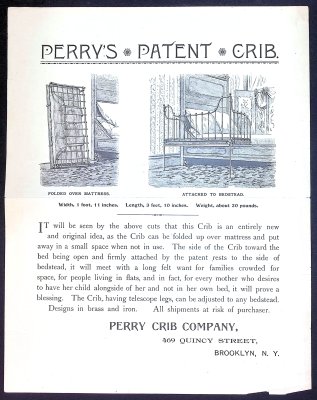
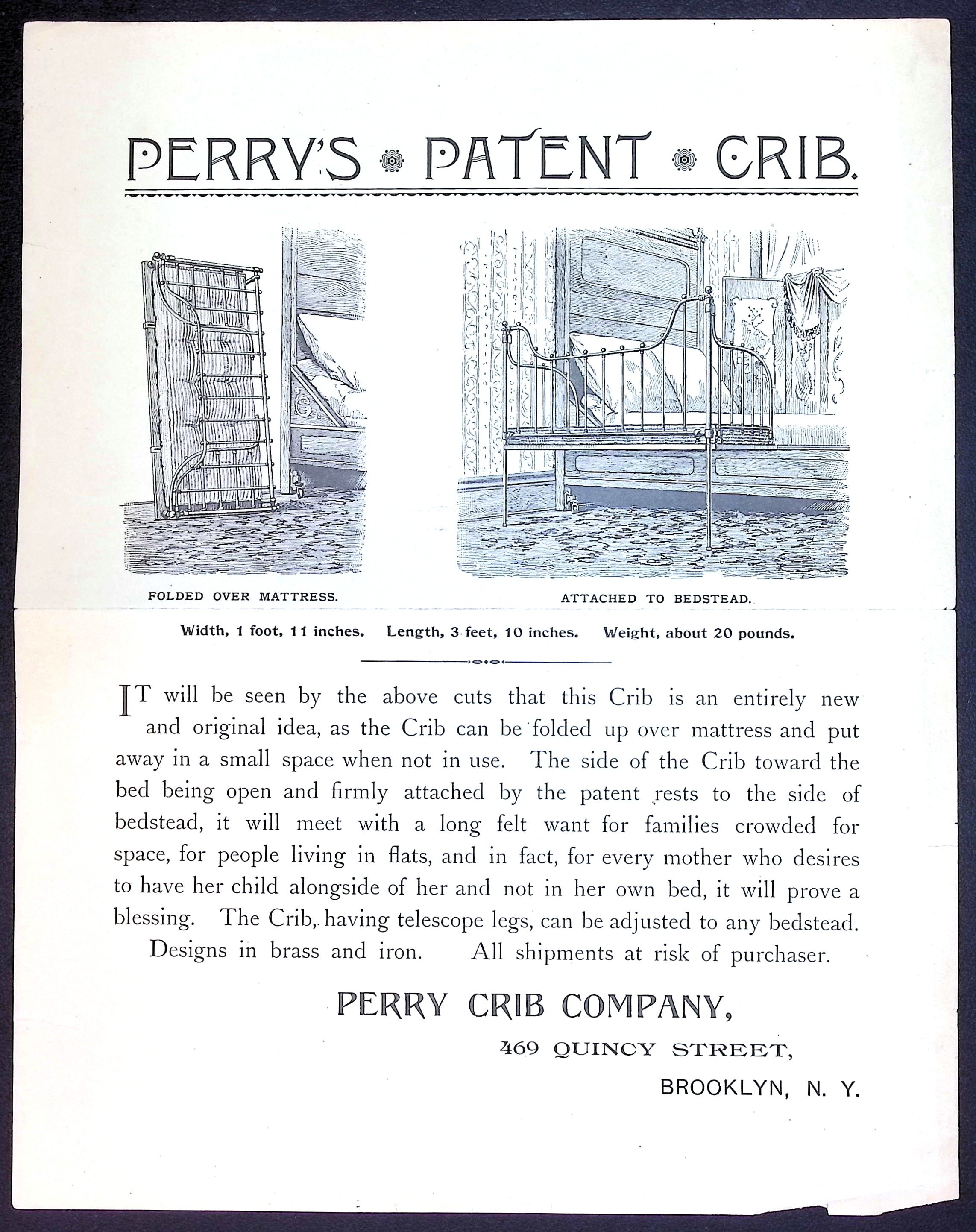
An uncommon illustrated advertising circular for Perry's Patent Crib, an ingenious folding infant bed designed to attach directly to an adult bedstead. The crib could be folded over its mattress when not in use, while telescoping legs allowed it to adjust to the height of the parents' bed.
Two large illustrations show the device both folded for storage and installed beside a bed. The advertising copy identifies a distinctly urban market, promoting the crib for ‘families crowded for space’ and ‘people living in flats,’ while appealing directly to mothers wishing to keep an infant alongside them without placing the child in the adult bed.
DESIGNED FOR SMALL SPACES.
The crib measured only 1 foot 11 inches wide by 3 feet 10 inches long and weighed approximately 20 pounds. Its combination of folding construction, adjustable legs, and attachment to the bedstead presents an early solution to problems still addressed by modern bedside sleepers: limited household space and keeping an infant close to a parent during the night.
The manufacturer offered the crib in brass and iron from its premises at 469 Quincy Street, Brooklyn.
PHYSICAL CHARACTERISTICS: ILLUSTRATED SALES EPHEMERA —
- Single sheet, approximately 12 by 9.5 inches, printed on one side only and folded horizontally through the center.
- Prominent decorative heading ‘PERRY'S PATENT CRIB.’
- Two detailed line illustrations show the crib ‘Folded Over Mattress’ and ‘Attached to Bedstead.’
- Printed specifications give width as 1 foot 11 inches, length 3 feet 10 inches, and weight approximately 20 pounds. Descriptive advertising text explains the folding construction, attachment system, and telescoping adjustable legs.
- Imprint at foot: Perry Crib Company, 469 Quincy Street, Brooklyn, N.Y.
- Blank verso.
- No printer, date, patent number, or inventor's name is stated on the circular.
CONDITION: Good overall for ephemeral advertising material of this type. Original horizontal center fold, with some weakening along the fold. Right edge somewhat fragile with small chips and short tears; lower corner bumped with minor loss and creasing. Light handling wear and occasional small edge imperfections.
Printed face remains clean and highly legible with strong illustrations and typography. Blank verso shows noticeable handling soil and scattered marks.
HISTORICAL SIGNIFICANCE: DOMESTIC LIFE IN THE URBAN AGE—INVENTING FOR THE APARTMENT.
More interesting than the crib alone is who Perry believed needed it and why. The circular explicitly markets the invention to ‘families crowded for space’ and ‘people living in flats’—language that places the product within the changing domestic conditions of increasingly dense American cities.
Its appeal to ‘every mother who desires to have her child alongside of her and not in her own bed’ also documents contemporary attitudes toward infant care, sleeping arrangements, and domestic convenience. The product combines furniture design with a social sales argument: the modern urban household needed furnishings that occupied less space and adapted to existing rooms.
The crib itself is an interesting precursor in concept to later bedside infant sleepers: adjustable in height, physically attached to the adult bed, open toward the parent, yet providing a separate sleeping space.
GENRES: Advertising Ephemera, Trade Advertising, Product Advertising, Juvenile Ephemera, Domestic Ephemera, Illustrated Ephemera, Invention and Patent Ephemera.
SUBJECTS: Infant Cribs, Baby Furniture, Child Care, Bedside Sleeping, Domestic Life, Apartment Living, Brooklyn New York, Patented Inventions, Space-Saving Furniture, Mothers and Infants, Early 20th-Century Advertising.
PURCHASE DIRECTLY HERE via this link: CLICK HERE
Please call with questions or to purchase 305.766.8270 [8:00 am to 8:00 pm EST]. Email [email protected]
We are pleased to work with Institutions according to their specific fiscal-year procurement requirements to facilitate acquisition.
Blind Horse Books ABAA

Richard Oates
816 Hanover Road
DeLand, Florida, 32724
United States
Phone: 3057668270
Cell: 3057668270
Featured Catalogue
Visit Website
Specialities
Travel, Exploration, Fine and Private Press



More Information
Booth 6
Shipping and Returns
Shipping: $6.00 flat-rate shipping within the United States. International shipping at cost.
Returns: Items may be returned within 30 days of receipt if not as described. We stand behind all descriptions, edition statements, and attributions.
Open Times
Please call or text with questions during the fair: 7:00am–7:00pm (Eastern). Links Provided to Purchase Directly in Listings.Additional Information
Blind Horse Books is a member of the Antiquarian Booksellers’ Association of America (ABAA) and adheres to its Code of Ethics.
We specialize in travel, exploration, fine press, and documentary material, with particular emphasis on printed ephemera, maps, photographic archives, and institutional publications from the nineteenth and twentieth centuries. Our inventory regularly includes material appropriate for academic, library, and museum collections.
We work carefully with provenance, condition, and bibliographic accuracy, and stand fully behind all descriptions and attributions. Items are selected with long-term research and collecting value in mind.
Blind Horse Books is operated by Richard and Dottie Oates and based in DeLand, Florida. We have been active in the antiquarian book trade since 1999 and are members of the ABAA, FABA, IOBA, and the Ephemera Society of America.
Building Your Great Collection, One Fine Book at a Time.