Cultural Images
Ray Beckwith
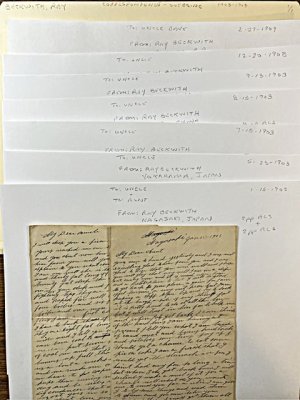
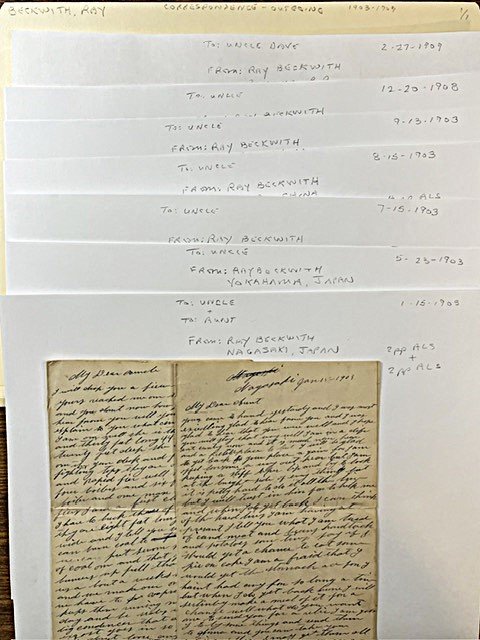
Group of Eight (8) Manuscript Letters (31 pages) Written by a U.S. Navy Serviceman from China & Japan in 1903 and Panama in 1908-09
Mentioning Life in the Navy; Observations of the Three Countries; and Attempting to Live a Christian Life Among Ill-Behaved Shipmates
SOLD
Item Details
Japan, China & Panama, Ray Beckwith, letter writer, 1903, 1908,1909
VG
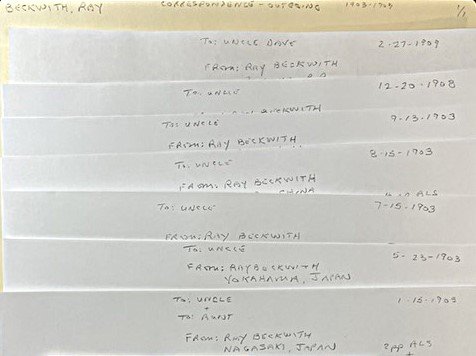
[CORRESPONDENCE] [JAPAN] [CHINA] Ray Beckwith. Group of eight (8) manuscript letters (31 pp) written by Ray Beckwith to his aunt and uncle in the United States from Japan, China and Panama in the years 1903 to 1909 while serving in the United States Navy. His letters contain information about the ships to which he was assigned; his troubled relationships with a woman back home and his father; his disappointment in the food, ill behavior of his ship mates, and the Navy in general; his attempt to live a Christian life in the midst of many distractions; living and health conditions in China; and a few of his activities in and impressions of Japan, China and the Republic of Panama. [21-1]
Eight ALS consisting of a total of 31 pages; no covers present; seven of the letters are addressed to “Uncle” and the other to “Aunt”. Six of the letters are dated between Jan 15 – Sept 13, 1903; two of which were written from Nagasaki, Japan, one from Yokohama, and three from Chefoo (now known as Yantai), China. The 1908 letter is from Panama and is dated December 20th. The 1909 letter is written on stationery of the “Young Men’s Christian Association Headquarters / Men of the Pacific Fleet, U. S. Navy” and names Beckwith’s ship as the U. S. S. South Dakota and is dated February 27th.
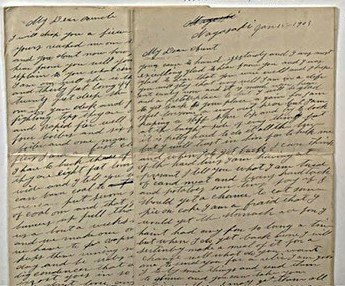
He writes his aunt on Jan 15th, 1903 that he is awful “lonesome, a way out hear [sic], but I am keeping a stiff upper lip and try to look at the bright side of everything, but it is pretty hard to do it all the time.” He goes on to write, “I tell you what I am tired of – can’d meat and beans - hardtack and potatoes some times. Say if I should get a chance to eat some pie or cake I am afraid that I would get the stomach ache for I hain’t had any for so long a time, but when I do get back home I will sertinly make a meal of it for a change.”
On that same day, Beckwith writes to his uncle and tells him about his naval ship. “Well, she is three hundred and thirty feet long, 44 wide and twenty feet deep. She carries 18 guns on the gun deck and four in her fighting tops. They are one pounders and rapid fire.” He goes on to write about the boilers, how much coal is used, the condenser, and states he is a first-class fireman. The ship’s top speed was about twenty-one knots but they only run ten knots most of the time. The crew numbered three hundred men.
The letter from Yokohama on May 23rd suggests he is now on another ship, one with 28 guns. He again details the boilers and how much coal the ship carries and writes that this ship’s crew numbers around 500 men. He doesn’t expect to be back to the U.S. for three years, but when his four years are up he hopes that he will be able to show as good a record as his father. “I don’t intend to let him beat me any and then I get to see lots of things that I wouldn’t if I hadnt of come in this outfit. I will see lots of things that the rest of my folks won’t and I guess I have seen lots of things already.” He then implies that the reason he is at sea in the Navy is because of a woman back home.
By July he is in Chefoo, a major port in northeast China, where on the 15th he writes about seeing men “running a round hear with the flesh droping of [sic] on their limbs with the lepercay [sic] and they are in all kinds of shapes and you can’t go a shore with out some of them coming up to you beging [sic] for money and you can see wimen [sic] all covered with big running sores all over them and it is caused by the sifless [sic] and pox. Oh, I tell you what. It is something offel [sic]. It will make any one sick for to look at them. I don’t see why the Lord lets them live and suffer they way that they do and you can go in and see them smoke opium and it costs you a dollar mix for to see it. Well, we have had four Chinamen come a board for the last two days and give us a show of slight hand performance and acrobatics, and say, they are surely fine and the little boy is double jointed and is the limberest thing that I ever saw.” He then complains about the effects of being around the coal in the boiler room of the ship and the lack of good food. And, sadly, he writes, “I haven’t heard from Father but once since I have been in the Navy. I guess that he doesn’t cair [sic] much about me or else he would write but I don’t cair ]sic] much after the way he used me but I can forgive him all the wrong that he has dun [sic] me and I will keep away from him and then we will be good friends.”
Still in Chefoo on August 15, 1903, he writes that he is “discusted [sic] with the Navy for I see so much drinking and fiting [sic] all the time. Well, you wanted to now [sic] if we ever have any preaching on board. Yes, well, we had a nice short sermon last Sunday.” He mentions his desire for good preaching and is alarmed about all the cursing of the crew around him. He is now on a third-class cruiser and “the fastest thing a float out hear [sic] and she can go where other boats can’t.” He writes that the ship’s 7,500 horse power engine is such that “when she goes full spead [sic] you wouldn’t stay on deck very long for she throws water all over her self and she is pretty low in the water.” He also tells his uncle that he had his rate changed to boiler maker which paid $65, a lot more than the $35 he had been making as a first-class fireman.
Beckwith’s August 13, 1903 letter from Chefoo states that he hasn’t yet gotten the new pay rate promised and thinks he would rather come home than stay and get the rate because he is tired of roaming around. He would rather settle down and live in peace the rest of his life. Tired of freezing in the winter, he wants to settle down in California.
Evidently, things did not work out for Ray Beckwith as he planned. By 1908 he is back in the Navy on board a ship in the Republic of Panama. In December of that year Beckwith writes that the country “don’t strike me very well for you couldn’t hire me to live here very long for it is…an offel dirty place and every thing is higher than a cat’s back.” He complains about the cost of meals and off-ship lodging and says the city is not very healthy, although the swamp lands are being filled in and poison applied to help kill the insects that spreads the fever. He remarks on improvements to the railroad and the digging of the canal – a “big ditch”. Then this news… “Well, while some of the boys were a shore a negro of the Washington killed a native barber hear [sic] and we discharged him from the Navy and turned him over to the republic so they can do just what they want to with him and I can tell you what, I pity him for they sure will fix him a plenty.”
In his last (February 27th, 1909) letter to Uncle Dave, Beckwith shares his intent to leave the sea and go to San Francisco where he plans to marry a German girl, buy a home, and settle down with a job. Although he doesn’t come right out and say it, it appears as though he may be going through, or just completed, a separation or divorce with a woman back home.
Cultural Images

Glenn Mason
8890 N.W. Ash Street
Portland, OR, 97229
United States
Cell: 503-939-6090

More Information
Booth 11
Shipping and Returns
All items are fully returnable for any reason within seven days of receipt. We would appreciate an immediate courtesy notification if you are returning an item. Please package for safe return, similar to the packaging when received. Prices are net with shipping charges extra. Payment in US funds and drawn on a US bank may be made by cash, personal/business check, money order, or PayPal prior to shipment of order. We can process bank card purchases through Square. Dealers receive the usual reciprocal discount. Institutions can be invoiced in accordance with their accounting procedures. All items will be shipped by US mail unless otherwise requested at, or close to, estimated cost. Sorry, we no longer ship out of the United States.
Open Times
No set business hours; we are "open" by appointment. We can be reached by email or phone most any time.Additional Information
Cultural Images specializes in vintage printed ephemera, photographs and photo albums, letters and diaries, early business records, documents, and unusual books in a variety of subjects. Cultural Images is a proud member of the ABAA and the Ephemera Society of America. If you would like to purchase a listed item, or would like further information about it, please either email or call us. Thank you. If you would like to receive Cultural Images' periodic illustrated E-lists, please send us your name and email address.